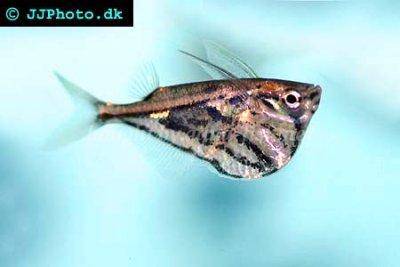
Marbled hatchetfish - Carnegiella strigata
Scientific name: Carnegiella strigata
Common name: Marbled hatchetfish
Family: Gasteropelecidae
Usual size in fish tanks: 4 - 5 cm (1.57 - 1.97 inch)
014
Recommended pH range: 5.8 - 7.5
Recommended water hardness: 2 - 12°N (35.71 - 214.29ppm)
0°C 32°F30°C 86°F
Recommended temperature range: 24 - 28 °C (75.2 - 82.4°F)
The way how these fish reproduce: Spawning
Where the species comes from: South America
Temperament to its own species: peaceful
Temperament toward other fish species: peaceful
Usual place in the tank: Top levels
Food and Feeding
Carnegiella strigata is a surface-dwelling insectivore that naturally feeds on small insects and invertebrates that fall onto the water surface. In the aquarium, they should be offered small floating foods. Suitable options include mosquito larvae, brine shrimp, daphnia, Cyclops, and finely crushed flakes. They readily accept frozen foods and high-quality micro pellets designed for small fish.
Because Marbled Hatchetfish feed almost exclusively at the surface, ensure that food remains floating long enough for them to consume it. They may struggle to compete with fast mid-water feeders. Feed small portions once or twice daily. A varied diet helps maintain their health and natural coloration.
Origin
Carnegiella strigata originates from the Amazon basin in South America, including Brazil, Guyana, and Suriname. They inhabit slow-moving streams, tributaries, and flooded forest areas with dense vegetation. These environments typically contain soft, acidic water and plenty of surface cover.
Tank Setup and General Care
Marbled Hatchetfish are strictly surface-dwelling fish and require a calm aquarium with minimal surface turbulence. Floating plants are strongly recommended, as they provide security and replicate their natural habitat. Dim lighting also helps reduce stress.
A tightly fitted lid is essential, as these fish are excellent jumpers. Hatchetfish can leap several centimeters above the water surface, especially when startled. Even small gaps may allow them to escape.
Use gentle filtration that does not create strong currents. Soft, slightly acidic water is preferred. Driftwood and plants can help simulate blackwater conditions. Although they occupy the upper levels, the rest of the tank can be arranged for other peaceful species.
Temperament and Compatibility
Carnegiella strigata is a peaceful shoaling species that should be kept in groups of at least six individuals. Keeping them in small numbers may result in stress and shy behavior. In larger groups, they become more confident and display natural schooling behavior.
Suitable tank mates include peaceful species such as small tetras, rasboras, dwarf cichlids, Corydoras, and other calm community fish. Avoid aggressive or very active species that may disturb them. Fast surface feeders may also outcompete them for food.
Sexing
Sexing Marbled Hatchetfish is difficult. Females are typically slightly larger and rounder, especially when carrying eggs. When viewed from above, females appear broader than males. Otherwise, there are no reliable visual differences.
Breeding
Breeding Carnegiella strigata in the aquarium is challenging and rarely achieved. They are egg scatterers that spawn among fine-leaved plants near the water surface. Soft, acidic water and dim lighting are usually required to trigger spawning.
After spawning, the adults should be removed, as they may eat the eggs. The eggs hatch within a few days, and the fry require very small foods such as infusoria or liquid fry food. Newly hatched brine shrimp can be offered once the fry are large enough.
Lifespan
With proper care, Marbled Hatchetfish typically live between 3 and 5 years. Stable water conditions, peaceful tank mates, and a calm environment help maximize their lifespan.
Short Description
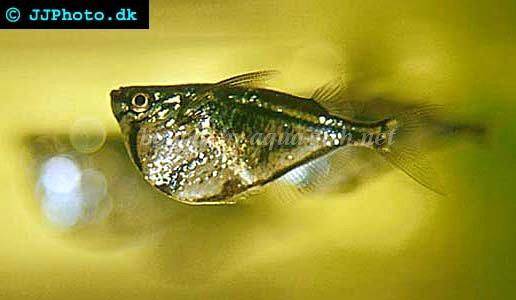
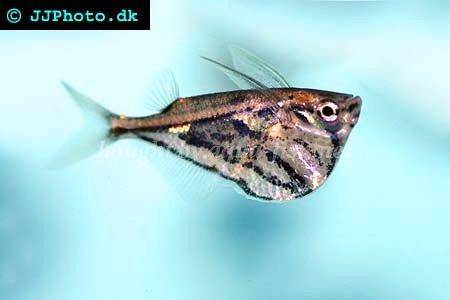
Carnegiella strigata is a peaceful surface-dwelling fish from the Amazon basin. This species should be kept in groups in calm aquariums with floating plants and tight-fitting lids. Their unique body shape and schooling behavior make them an attractive addition to peaceful community tanks.
Pictures
Bought by aqua-fish.net from jjphoto.dk.
 Spotfin