Aquaponics for Beginners: Growing Fish and Plants Together
Aquaponics combines fishkeeping and plant production in one recirculating system. Fish, plants and beneficial microorganisms all depend on the same water, so success comes from keeping the whole system in balance rather than treating each part separately.
Aquaponics lets you raise fish and grow plants in one recirculating system. Fish waste supplies nutrients that plants can use, microorganisms convert toxic nitrogen compounds into forms that are easier for plants to absorb, and the treated water returns to the fish tank.
The important point is that aquaponics is not simply an aquarium with plants sitting above it. Fish health, plant growth, beneficial microorganisms, water flow, oxygen, temperature, feeding and water chemistry all affect one another.
For most first-time home growers, a small media-bed system is usually the easiest place to learn. The grow bed supports the plants, provides a large surface for beneficial microorganisms and can also help trap and process solid waste.
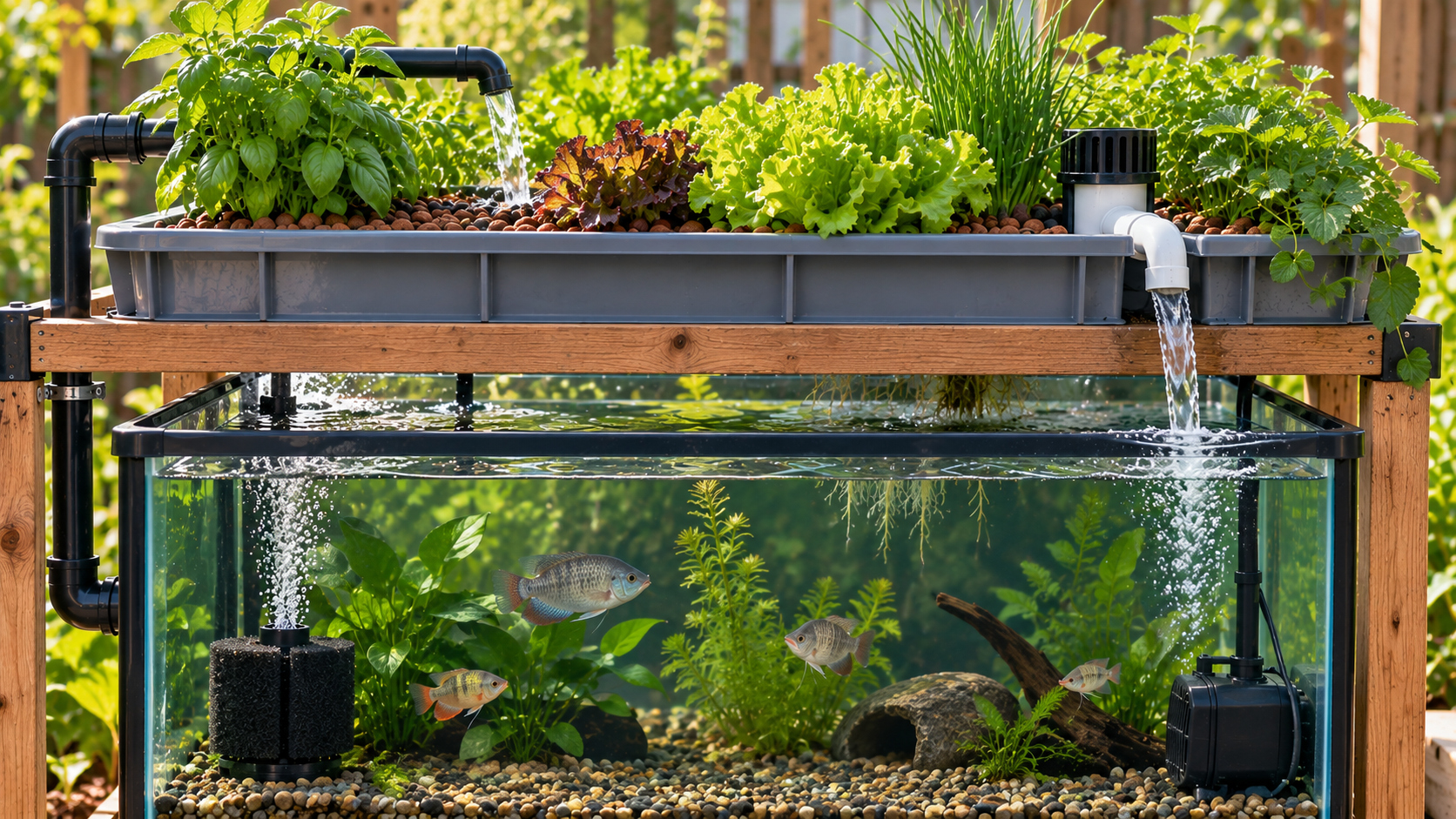
How Aquaponics Works
Fish release nitrogenous waste, including ammonia. Nitrifying microorganisms convert ammonia to nitrite and then to nitrate. Plants take up nitrate and other nutrients as they grow, while water continues to circulate through the system.
This relationship only works when the biological load, plant growth, filtration, oxygen and water flow remain reasonably balanced. A large fish population cannot simply be added to a new system and expected to support plants immediately.
Aquaponics can also make an excellent school or college project because it combines biology, chemistry, water-quality monitoring and practical system design. Students who are balancing several assignments sometimes look for additional support with editing, structure or other written coursework through professional essay writing services, while still keeping their own measurements, observations and conclusions at the centre of the project.
Choosing an Aquaponics System
Beginners will most often encounter three plant-production designs: media beds, deep water culture (DWC) and nutrient film technique (NFT). All three can work, but they differ significantly in complexity and tolerance of mistakes.
| System | How it works | Beginner difficulty | Best suited to | Main trade-off |
|---|---|---|---|---|
| Media bed | Plant roots grow in gravel, expanded clay or another inert medium | Low to moderate | First home systems, herbs, leafy greens and mixed plantings | Media can trap solids and eventually needs maintenance |
| Deep water culture | Plants sit in floating rafts with roots extending into oxygenated water | Moderate | Larger quantities of leafy greens | Usually needs good solids removal and strong aeration |
| Nutrient film technique | A shallow stream of water flows through narrow plant channels | Moderate to high | Compact systems and lightweight plants with smaller root systems | Root blockages or interrupted flow can quickly cause problems |
Media beds are generally the most forgiving option for a first small system because the growing medium can provide plant support, biological filtration and some solids filtration at the same time. DWC and NFT systems normally benefit from more deliberate removal of solid waste before water reaches the plant section.
There is no universally best design. The correct choice depends on available space, the plants you want to grow, how much plumbing you are comfortable maintaining and how much time you want to spend monitoring the system.
Step 1: Choose the Simplest System That Fits Your Space
For a small first project, simplicity is an advantage. A media-bed setup gives a beginner a clear view of how the fish tank, plant bed, pump, filtration and water flow interact without requiring several separate treatment stages.
DWC becomes attractive when the goal is repeated production of leafy vegetables. NFT can save space and can be arranged efficiently, but it is less tolerant of root blockages, pump failures and poor flow.
Step 2: Plan Water Flow Before Adding Fish or Valuable Plants
Assemble the fish tank, pump, pipework, grow area, drains and aeration before stocking. Run the complete system with water and inspect every connection for leaks, poor flow and places where roots or solids could eventually create a blockage.
Consider what happens if a hose slips, a fitting leaks or the pump stops. The fish tank should not be able to drain to a dangerous level because of a single failed connection, and pumps and filters should remain accessible for cleaning.
Before stocking, simulate a power failure. Switch the pump and aeration off, observe where the water settles and make sure nothing overflows or siphons unexpectedly. Restore power and confirm that pumps, siphons and water flow restart correctly.
Aeration deserves the same attention as circulation. Fish, plant roots and nitrifying microorganisms all depend on oxygen. Oklahoma State University's principles of small-scale aquaponics notes that dissolved oxygen above 5 mg/L is ideal for fish, plants and microorganisms and recommends supplemental aeration.
Step 3: Establish the Nitrogen Cycle Before Normal Stocking
A new aquaponics system needs time to establish the microbial community that converts ammonia into nitrite and then nitrate. Clear water does not mean the biofilter is ready. A new system may look perfect while still being unable to process the waste produced by a normal fish load.
For a first system, fishless cycling is a useful approach because the biological filter can be established without deliberately exposing fish to elevated ammonia or nitrite. A controlled ammonia source is added, and water tests are used to follow the development of nitrification.
Oklahoma State University's guide to nitrification and maintenance describes cycling with and without fish and shows how ammonia, nitrite and nitrate change as nitrifying populations become established.
Do not judge readiness by the calendar alone. Temperature, pH, the ammonia source, microbial development and system design all affect the cycling period. Test results are more useful than an arbitrary number of days.
Step 4: Choose Fish and Plants That Like Similar Conditions
Fish and plants should be selected as a pair rather than as two separate shopping decisions. Combining warm-water fish with plants that prefer cool conditions forces the system toward a compromise that may suit neither side particularly well.
Oklahoma State specifically recommends matching organisms with compatible temperature requirements and gives warm-water tilapia with basil as one example. Tilapia, however, should only be kept where they are legal and appropriate.
Leafy greens and culinary herbs are practical first plants because they have relatively modest nutrient requirements. The FAO's practical aquaponics guidance notes that leafy greens perform very well and also identifies tomatoes, cucumbers and peppers as common fruiting crops.
Fruiting plants generally demand more nutrients and are easier once the system is mature. Fish choice should also take account of climate, water temperature, local regulations, whether the fish are ornamental or intended for food, and the availability of healthy stock.
| Conditions | Possible fish choice | Suitable starter plants | Main consideration |
|---|---|---|---|
| Warm system | Tilapia where legal and appropriate | Basil, lettuce and warm-season greens | Requires reliably warm water |
| Cooler system | Cold-water species suited to local conditions and regulations | Lettuce and cool-season greens | Higher oxygen requirements may apply |
| Ornamental home setup | Suitable aquarium fish matched to the system | Herbs and smaller leafy plants | Fish harvest is not the goal |
| Mature nutrient-rich system | Species matched to climate and water temperature | Tomatoes, peppers and cucumbers | Fruiting plants often need additional nutrients |
Step 5: Learn the Six Water Readings That Matter Most
Beginners should become comfortable with pH, ammonia, nitrite, nitrate, temperature and dissolved oxygen. Together, these measurements reveal whether biological filtration is functioning and whether conditions remain suitable for fish, plants and microorganisms.
There is no single perfect pH for every aquaponics system because fish, plants and nitrifying microorganisms have different preferences. Oklahoma State recommends maintaining aquaponic systems broadly around pH 6.5 to 7.5, with roughly 6.8 to 7.2 often used as a practical compromise.
| Measurement | Why it matters | What a change may tell you |
|---|---|---|
| pH | Affects fish, microorganisms and nutrient availability | The chemical balance of the system is shifting |
| Ammonia | Produced from fish waste and can be toxic | The biofilter may be immature, overloaded or disrupted |
| Nitrite | Intermediate product of nitrification and toxic to fish | Cycling may be incomplete or biological filtration may be struggling |
| Nitrate | End product of nitrification and a plant-available nitrogen source | Shows nitrification and nutrient input, but excessive accumulation still needs attention |
| Temperature | Affects fish, plants, microorganisms and oxygen availability | The system may be moving outside the preferred range of its inhabitants |
| Dissolved oxygen | Needed by fish, plant roots and nitrifying microorganisms | Aeration, temperature or stocking density may need attention |
Step 6: Feed the System, Not Just the Fish
Fish feed is the main nutrient input into most aquaponics systems. Feed becomes fish biomass, solid waste and dissolved nutrients, so changing the feeding rate affects almost every other part of the system.
More food can mean more ammonia and a greater load on the biofilter. Uneaten food can consume oxygen as it decomposes and should be removed rather than allowed to accumulate. A sudden loss of appetite can also be an early warning that temperature, oxygen or water quality is unsuitable.
Fish waste is not automatically a complete plant fertilizer. Even a well-balanced aquaponics system can develop nutrient deficiencies. Oklahoma State notes that iron, potassium and calcium may sometimes require supplementation, while other deficiencies can also occur depending on feed, crops and source water.
The FAO's practical rules also emphasize balance between plants and animals. Too many fish for the plant and filtration capacity can create water-quality problems, while too little nutrient input can limit plant growth.
Step 7: Follow a Simple Maintenance Routine
Aquaponics becomes much easier to manage when checks happen routinely instead of only after something looks wrong. Daily observation takes only a few minutes once you know what normal fish behaviour, water flow, plant colour and pump noise look like.
- Check fish behaviour and appetite
- Confirm pumps and aeration are running
- Look for leaks, blocked pipes and low water levels
- Remove obvious uneaten feed and dead plant material
- Check that water is moving through every part of the system
- Test pH, ammonia, nitrite, nitrate and temperature
- Monitor dissolved oxygen where practical
- Inspect roots and leaves for developing problems
- Remove accumulated solids
- Record important changes and adjustments
- Service pumps and mechanical filters when flow declines
- Remove roots or solids that restrict pipework
- Inspect aeration equipment and backup arrangements
- Correct confirmed plant nutrient deficiencies carefully
Biological filtration should be treated differently from ordinary mechanical equipment. Do not sterilize biofilter media or rinse it aggressively in chlorinated tap water. If media needs cleaning, preserve the beneficial microbial population by using system water or suitably dechlorinated water and avoid allowing biological media to dry out.
Make only one or two important changes at a time whenever possible. If feeding, pH, stocking density, aeration and planting density are all changed together, it becomes difficult to know which change solved the original problem or created the next one.
Common Aquaponics Mistakes Beginners Can Avoid
Most beginner problems become easier when the first system is kept small and changes are made deliberately. Starting conservatively gives the biological side of the system time to establish and makes troubleshooting far easier.
- Adding a normal fish load before the nitrogen cycle is established
- Selecting fish and plants with conflicting temperature requirements
- Assuming clear water means safe water
- Feeding more than the fish and biofilter can process
- Ignoring aeration, backup power and pump failures
- Changing pH or other water chemistry too aggressively
- Ignoring plant nutrient deficiencies
- Allowing roots or solids to restrict water flow
- Expanding before the first system is stable
FAQ
Is aquaponics difficult for a beginner?
Aquaponics is manageable when the first system is small and simple. A media-bed setup lets a new grower learn water flow, nitrification, fish care, planting and routine testing without immediately managing a large production system. Maintaining biological balance is usually more challenging than physically assembling the tank and grow bed.
What are the easiest plants to grow in aquaponics?
Leafy greens and culinary herbs are generally the best starting point because their nutrient requirements are relatively modest. Lettuce, basil, Swiss chard, pak choi and watercress are common examples. Fruiting crops such as tomatoes, cucumbers and peppers can also work, but usually become easier once the system is mature and producing more nutrients.
How long should an aquaponics system cycle?
There is no single number of days that proves a system is ready. Cycling depends on temperature, pH, microbial development, the ammonia source and system design. Use ammonia, nitrite and nitrate test results to judge progress rather than relying on the calendar alone.
Does aquaponics save water?
Aquaponics recirculates water instead of continuously discarding it, so it can be highly water-efficient compared with conventional production. Actual water use still depends on system design, evaporation, climate, leakage, crop choice and management.
Can aquaponics be used indoors?
Yes. An indoor system can work well if temperature, lighting, oxygen, humidity and water quality are managed appropriately. Indoor plant production may require artificial grow lights and moisture control, but it can also make inspection and year-round temperature management easier.
References and Further Reading
- Oklahoma State University Extension: Principles of Small-Scale Aquaponics
- Oklahoma State University Extension: Nitrification and Maintenance in Media Bed Aquaponics
- Food and Agriculture Organization of the United Nations: Seven Rules of Thumb to Follow in Aquaponics